
National Marzipan Day: A Sweet Journey Through History, Craft, and Italian Indulgence
There’s something quietly enchanting about marzipan—the way it yields under gentle pressure, neither quite dough nor quite candy, but something more delicate, more elusive. Its pale golden hue hints at almonds sun-warmed in distant groves, while its aroma carries whispers of confectioners’ kitchens and centuries-old traditions. Bite into it, and the experience unfolds slowly: a soft, almost velvety texture dissolving into a sweet nuttiness that feels both indulgent and refined. It is not the kind of sweetness that shouts. Marzipan murmurs. It invites you closer.
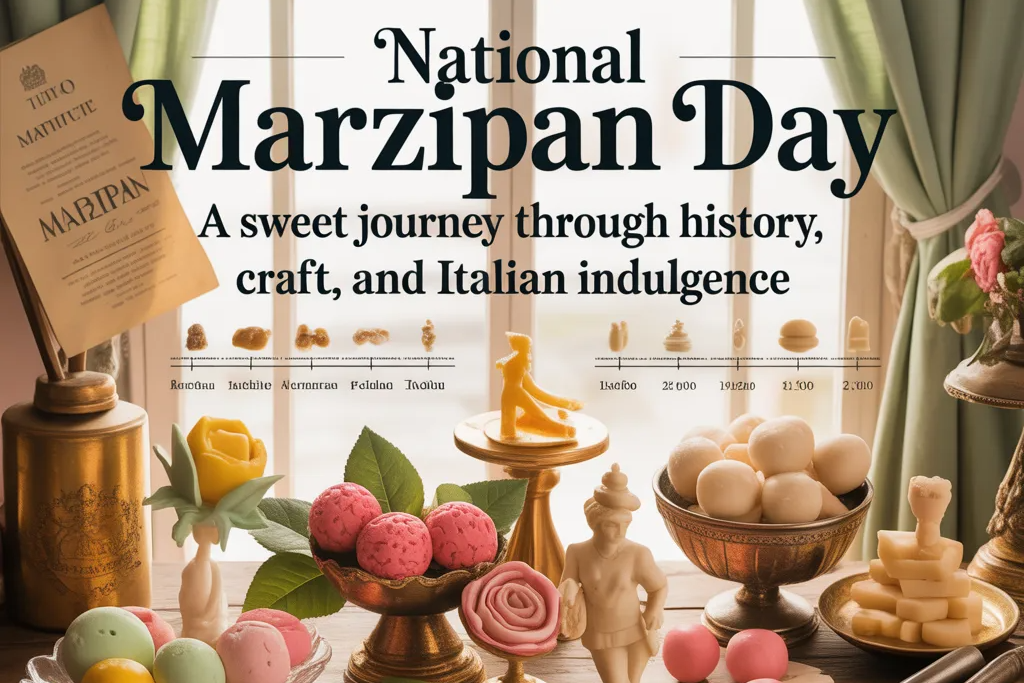
Every year, on January 12th, this understated delicacy steps into the spotlight for National Marzipan Day—a celebration that feels less like a commercial holiday and more like an invitation to rediscover one of the world’s most storied confections. For those who already love it, the day is a chance to savor nostalgia and craftsmanship. For the uninitiated, it’s a doorway into a rich culinary history that stretches across continents and centuries.
To understand marzipan is to understand how food travels, evolves, and binds cultures together. It is a confection born not from a single place, but from a tapestry of influences—Middle Eastern ingenuity, European refinement, and centuries of trade that carried almonds, sugar, and ideas from one corner of the world to another.
A Sweet Journey Through Time
The origins of marzipan are as layered as the confection itself, and like many culinary legends, they resist a single, tidy narrative. Some trace its beginnings to the Middle East, where almond-based sweets have been cherished for over a thousand years. In Persia and the Arab world, almonds were ground and blended with sugar or honey to create pastes flavored with rose water or orange blossom. These early confections were luxurious, often reserved for the wealthy or for special occasions, and they carried an aromatic elegance that still defines marzipan today.
As trade routes expanded during the Middle Ages, almonds and sugar made their way into Europe, particularly through Spain and Sicily—regions deeply influenced by Arab culture. In Andalusia, Moorish confectioners refined almond pastes into something closer to what we now recognize as marzipan. Meanwhile, in Sicily, the tradition took on a distinctly Italian character. The nuns of Palermo’s convents became renowned for their intricate marzipan creations, shaping the paste into astonishingly lifelike fruits known as frutta martorana. These were not merely sweets; they were edible art, displayed during religious festivals with reverence and pride.
Germany, too, became a central chapter in marzipan’s story. The city of Lübeck emerged as a hub for its production, developing a style that emphasized a higher almond content and a more restrained sweetness. German marzipan is often considered among the finest in the world, its flavor richer and more complex, its texture smoother and more luxurious. From there, marzipan spread across Europe, becoming a staple in festive traditions from Christmas stollen in Germany to elaborate wedding cakes in England.
In Italy, marzipan found a particularly poetic expression. Beyond Sicily, it became intertwined with the country’s broader pastry culture—used in cakes, cookies, and confections that celebrate both simplicity and artistry. It is here that marzipan feels most at home, not as an exotic import but as a natural extension of a cuisine that honors ingredients and craftsmanship above all else.
The Meaning Behind National Marzipan Day
National Marzipan Day may not carry the weight of centuries-old festivals, but its spirit is rooted in appreciation—for heritage, for flavor, and for the artisans who keep traditions alive. Celebrated each January 12th, the day arrives in the quiet aftermath of the holiday season, when indulgence lingers but the frenzy has faded. It’s a moment to pause and savor something special, something that doesn’t rely on spectacle to make its mark.
For food lovers, the day is an opportunity to revisit a confection that often gets overshadowed by flashier desserts. Marzipan doesn’t compete with towering cakes or molten chocolate centers. It offers something subtler: a connection to history, a taste that feels both familiar and intriguingly different. For culinary communities, it’s a chance to highlight craftsmanship—the skill required to balance sweetness and texture, to shape and mold, to transform simple ingredients into something enduring.
There’s also something quietly rebellious about celebrating marzipan in an era dominated by processed sweets. It reminds us that some of the best flavors come from restraint, from respecting the natural qualities of ingredients rather than overwhelming them.
The Craft Behind the Confection
At its heart, marzipan is deceptively simple. Almonds, sugar, and a touch of liquid—often rose water or almond extract—are all it takes. But simplicity, as any seasoned cook will tell you, is where true mastery lies.
The process begins with blanching almonds to remove their skins, revealing the pale kernels beneath. These are then finely ground, traditionally using stone mills, to create a paste that retains the almonds’ natural oils. Sugar is added gradually, the mixture worked until it reaches a smooth, pliable consistency. Too much sugar, and the marzipan becomes overly sweet and stiff. Too little, and it lacks structure. The balance is everything.
In some traditions, egg whites are incorporated to bind the mixture and give it a slightly firmer texture. In others, particularly in the Middle East, rose water or orange blossom water is used to infuse the paste with a fragrant lift. Each variation reflects a different cultural sensibility, a different understanding of what marzipan should be.
Modern artisans have taken this craft even further, experimenting with flavor infusions and techniques that push the boundaries of tradition while respecting its core. Pistachio marzipan, chocolate-dipped marzipan, marzipan infused with citrus zest or spices—the possibilities are endless, yet the essence remains unchanged.
What sets exceptional marzipan apart is not just its ingredients, but the care with which it is made. The best versions feel almost alive in your hands, soft yet structured, yielding without crumbling. They carry a depth of flavor that lingers, revealing layers of nuttiness and sweetness that unfold slowly.
From Confection to Canvas
Marzipan’s versatility is one of its most remarkable qualities. It can be rolled, sculpted, molded, and shaped into forms that range from the elegantly simple to the intricately detailed. In many cultures, it is used to create decorative figures—tiny animals, fruits, and flowers that look almost too beautiful to eat.
During the holiday season in Europe, marzipan becomes a centerpiece. It is tucked into pastries, layered into cakes, and shaped into festive treats that evoke a sense of tradition and celebration. In Germany, it is an essential component of stollen, adding richness and depth to the dense, fruit-studded bread. In the UK, it forms the smooth, sweet layer beneath the icing of Christmas cakes.
In Italy, marzipan’s artistic potential reaches its peak. The frutta martorana of Sicily are legendary, their realism so striking that they are often mistaken for actual fruit. Each piece is hand-painted, each detail meticulously crafted, transforming marzipan into a medium of expression as much as a culinary delight.
Yet marzipan is not confined to tradition. Contemporary chefs have embraced it in new and exciting ways, incorporating it into plated desserts, pairing it with unexpected flavors, and reimagining its role in modern cuisine. It might appear as a delicate layer in a mille-feuille, a subtle accent in a chocolate dessert, or even as a savory-sweet component in innovative dishes.
A Table Worth Gathering Around: Sac’s Place
If there’s a place where the spirit of marzipan—its reverence for tradition, its celebration of craftsmanship—feels especially at home, it’s in the warm, welcoming embrace of a truly great Italian restaurant. And in Astoria, Queens, Sac’s Place stands out as just that kind of destination.
Walking into Sac’s Place feels like stepping into a story that’s still being written. The atmosphere carries the quiet confidence of a restaurant that knows exactly what it is: authentic, unpretentious, and deeply committed to quality. The aroma of garlic, tomatoes, and fresh herbs greets you first, followed by the gentle hum of conversation and the clinking of glasses.
Italian cuisine, at its best, is about honoring ingredients and traditions while allowing room for creativity. It’s about understanding that a dish doesn’t need to be complicated to be extraordinary. This philosophy extends naturally to desserts, where the influence of confections like marzipan is felt in subtle, meaningful ways.
At Sac’s Place, the dessert menu reflects this balance. While you may not find marzipan in its most traditional forms, you will encounter the same respect for flavor and texture that defines it. Almond notes appear in pastries and sweets, woven into recipes that feel both classic and fresh. It’s the kind of place where dessert isn’t an afterthought—it’s a continuation of the story that began with the first bite of pasta.
For those looking to celebrate National Marzipan Day with a touch of Italian elegance, Sac’s Place offers the perfect setting. It’s not about ticking a box or following a trend; it’s about experiencing food in a way that feels genuine and memorable. You can explore their offerings and get a sense of what awaits at https://astoriaitalian.com/, but the real magic happens when you’re seated at the table, savoring each moment.
Marzipan in the Modern World
In a culinary landscape that often chases novelty, marzipan remains steadfastly itself. It doesn’t reinvent itself for the sake of attention. Instead, it evolves quietly, finding new expressions while staying true to its roots.
Part of its enduring appeal lies in its adaptability. It can be luxurious or humble, ornate or simple. It fits as comfortably in a centuries-old European bakery as it does in a contemporary pastry kitchen experimenting with new techniques. It bridges the gap between past and present, offering a taste that feels timeless.
There’s also something deeply comforting about marzipan. Perhaps it’s the way it connects us to traditions, to celebrations that have been shared across generations. Or perhaps it’s simply the pleasure of its flavor—a reminder that sweetness can be subtle, that indulgence doesn’t have to be overwhelming.
Celebrating the Day
National Marzipan Day is not about grand gestures. It’s about small, meaningful ones. It might be as simple as seeking out a piece of high-quality marzipan and taking the time to truly appreciate it. It might mean trying your hand at making it, feeling the transformation of almonds and sugar beneath your fingertips. Or it might involve sharing it with others, introducing someone new to its quiet charm.
For those who prefer to celebrate through experience, a visit to a place like Sac’s Place offers a different kind of indulgence—one that captures the essence of what marzipan represents. It’s about savoring craftsmanship, enjoying flavors that are thoughtfully prepared, and connecting with the traditions that make food so much more than sustenance.
There’s a certain beauty in choosing to celebrate something as understated as marzipan. In a world that often favors the loud and the extravagant, it invites us to slow down, to pay attention, to find joy in the details.
A Sweet Invitation
As January 12th approaches, consider this an invitation—not just to taste marzipan, but to experience it. Seek out the versions that honor its heritage, that respect the balance of flavors that has defined it for centuries. Let it linger on your palate, let it tell its story.
And if you find yourself in Astoria, take a seat at Sac’s Place. Order generously, linger over your meal, and leave room for dessert. Let the experience remind you that the best food is not just about flavor, but about connection—to history, to culture, to the people who craft it with care.
National Marzipan Day may come and go in a single day, but its spirit is something you can carry with you. It lives in every bite that makes you pause, every flavor that sparks curiosity, every meal that feels like a celebration.
So go ahead—embrace the sweetness, honor the tradition, and treat yourself to something extraordinary.